Case study
Drills
Workshop Snapshot: Micro-Diameter, Deep Coolant-Through Drills (Before Coating)
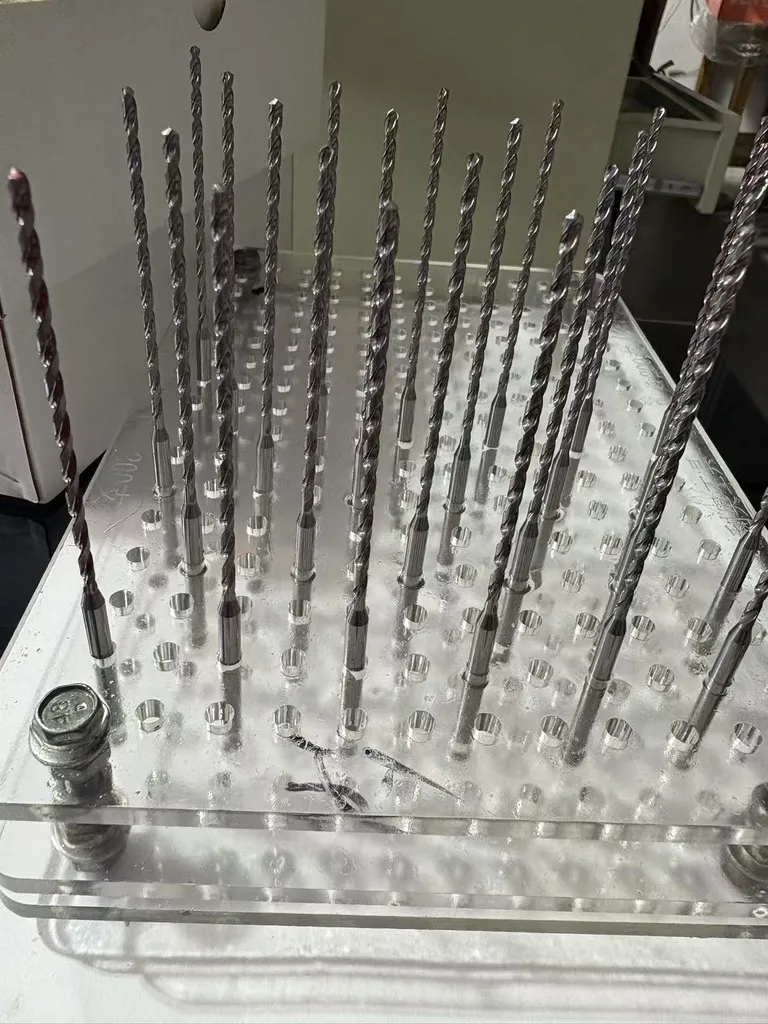
The image shows solid carbide coolant-through drills at a stage customers rarely see: after precision grinding, before PVD or other coatings are applied. At this moment the geometry is naked — any taper in the coolant bore, any flute runout, or any asymmetry in the cutting edges is visible to our inspectors and will show up later as poor hole quality or early tool failure.
These tools combine two difficult requirements at once: a small diameter and a flute length suited to deep-hole drilling. The length-to-diameter ratio is aggressive: the carbide column is slender, yet it must carry a centred coolant passage, clear chips along a long helical path, and remain stiff enough not to whip when the customer runs at realistic speeds and feeds. That combination is exactly where ordinary shops hit the limit of their grinding and deep-hole equipment.
Manufacturing follows a controlled sequence: blank preparation, accurate drilling or gundrilling of the internal coolant channel, multi-pass flute and point grinding, and full-length dimensional checks. Straightness and runout are managed over the entire functional length — not only near the point — because deep holes punish cumulative error. Only a narrow tier of factories can hold these tolerances repeatably on micro-diameter, long-reach coolant-through bodies.
Coating is applied only after the substrate geometry is proven. If your application needs micro-diameter deep holes with through-tool coolant — medical, instrumentation, mould, energy, or other precision sectors — send diameter, flute length or depth requirement, material, and coolant pressure. We will align process capability in our workshop with your print, not only a catalogue number.
Custom tooling
Discuss your next custom tool
Send drawings, material, and target cycle time. Our application team typically responds within one business day with feasibility feedback and next steps.